What does Art-Activism have to do with the Green Transition?
A Conversation with Madeleina Kay
Interview for Salto Green by Ally ZLATAR
Who is Madeleine Kay ?
She is a British artist, writer and activist from Sheffield, England. Kay has written, illustrated and self-published nine books, and performed at events and festivals across the UK and Europe, using creative action to support a variety of social and environmental justice and human rights campaigns. In 2018, Kay was awarded the Young European of the Year title by the Schwarzkopf Foundation, and in 2020 received the European Charlemagne Youth Prize from the Karlspreis Foundation and the European Parliament.
Art practice and green transition
-
Your work sits at the intersection of art, storytelling, and activism. How do you see creative practices contributing to the broader green transition and environmental awareness today?
For me, creative practices are as much about communication as they are about aesthetics. Art that is purely decorative, or functions primarily as a commodity in a capitalist marketplace, is of little interest to me. Creative practices that most inspire me are those that strive for social change, make profound statements which provoke deep reflection on the state of the world, or bring communities together through dialogue, empowerment and collective action.
And it is exactly these creative practices which have the capacity to contribute to the broader green transition and environmental awareness by mobilising and educating the public about environmental problems and solutions, supporting environmental initiatives with outreach and fundraising, and by attracting media attention to the cause.
-
You previously worked on the environmental arts project Moorland Wonderscape in the Peak District. What did that experience teach you about engaging communities, especially young people or disadvantaged groups, with environmental issues through art?
I was living in the Peak District at the time, and I had the opportunity to deliver a project with funding from O2 Think Big, using arts to engage young people and disadvantaged groups from urban areas with the countryside on their doorstep. I partnered with the Moors for the Future Partnership, which was based in the village of Edale, where I lived, and the University of Sheffield Landscape Architecture Department who wanted to collect data on access of urban populations to the countryside.
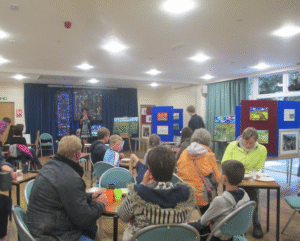
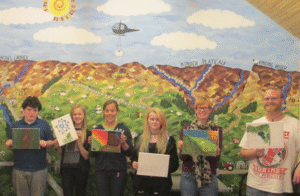
The groups who participated included people experiencing homelessness, young carers and pensioners from Manchester and Sheffield. The project funded them to travel to the Peak District and spend a day visiting the Moorland Centre, participating in wildlife walks and art workshops.
The Moors for the Future partnership was working on revegetating the Moorlands to support local wildlife and biodiversity and reduce the flood risk in Sheffield after the devastating 2007 United Kingdom floods. We discussed this with participants before taking them on a wildlife walk where we identified different species.
The arts workshops were an opportunity for participants to reflect on everything they had learned and experienced, and gave them an artefact to take home which hopefully provided a lasting memory. I also delivered arts workshops with families at local community events, such as Edale Country Day and Hope Show. All of the artworks were documented in a project book and presented in two exhibitions, one in Edale and one in Sheffield, to showcase the project and engage a wider audience in a dialogue about the environmental issues it addressed.
-
Many climate discussions can feel technical or inaccessible. How can art translate complex environmental challenges into narratives that communities can emotionally connect with?
Working on campaigns means that I have spent a lot of time listening to speeches, panel discussions and talks and I can’t state how highly I value brevity. It is an incredible skill to communicate a complex issue clearly without boring your audience with tedious and unnecessary detail. There are also bonus points if you can also engage and entertain your audience with humor and relatable anecdotes while communicating about serious issues.
This is where art can play a role, as an incredibly powerful tool which allows us to communicate complexity with engaging and succinct impact. You’ve heard of the expression “a picture tells a thousand words”? In the “attention economy” you have to grab aattention, get your point across quickly and provoke an emotional response that creates a lasting impact. Art is a tool which can achieve that.
Furthermore, I would push back on the need for climate discussions to be so technical that they become inaccessible in the first place. Yes, policy experts and decision makers need to engage with that level of detail, but for the wider public it isn’t necessary to bamboozle them with technical information in order to engage them with environmental issues. Art doesn’t require a high level of understanding or technical knowledge. Instead, it can break down complexity into a universal language that makes the knowledge you are trying to communicate far more accessible for people of all ages and backgrounds.
Participatory art gives everyone a voice
-
From your perspective as both an illustrator and activist, what unique role does storytelling play in shaping public attitudes toward sustainability and ecological responsibility?
Storytelling is the oldest way of communicating and transferring knowledge between generations, and it is still an incredibly impactful way to create personal resonance and memorable impact. Stories can make inaccessible topics relatable through humanizing narratives and anecdotes that relate to daily life, as well as platforming protagonists that serve as role models to others.
The media utilised this storytelling tactic in 2018-19 when reporting on the environmental youth movements, where Greta Thunberg became the chosen protagonist for the empowering story of a lone young woman believing she could change the world and nobody can doubt the worldwide impact that narrative achieved.
In my own practice, I constantly deploy storytelling to support a variety of different campaigns, through self-published books, speeches at events and social media content. For example, in 2017 I became involved in Sheffield’s ‘Save Our Trees’ campaign to stop the council cutting down the city’s street trees as part of a city-wide road-resurfacing contract.
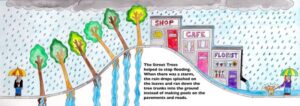
The protests received national attention when grannies were arrested for obstructing workers by chaining themselves to the trees, some of which were over a hundred years old or planted in memory of soldiers who had died in the war. After becoming involved with the campaign, I quickly realised that there was a deficit of knowledge among the public as to the socio-economic and environmental benefits of street trees, such as providing flood mitigation and wildlife corridors, as well as the historical importance of some of Sheffield’s trees.
So I wrote, illustrated and self-published a children’s book to support the campaign that communicated these key benefits, with a cute squirrel character who saves the day by stopping “Mr Nook” and “Mrs Cranny,” the evil pavement inspectors, from cutting down the trees. The story was full of humor, and the illustrations made a lot of reference to the city of Sheffield to emphasise the personal connection of the campaign to residents, alongside highly educational content supported by easily understandable illustrations.
-
Communities with fewer opportunities are often disproportionately affected by environmental challenges. How can participatory art projects empower these communities to have a voice in conversations about climate and the green transition?
The impacts of climate change are undoubtedly going to affect disadvantaged communities the most, especially those in the global south, who don’t have the means to escape or mitigate its impacts. Participatory art projects can empower these communities by giving a voice to the voiceless, enabling them to communicate their lived realities and the personal impacts of the environmental challenges they face with emotional resonance and thereby impress the need for global action on climate change.
Participatory art projects also help by bringing these communities together, connecting individuals who are facing similar challenges with each other, providing them with a feeling of solidarity, a louder collective voice and a network that can facilitate problem solving, resource sharing and advocacy. Making art is also an inherently creative process, and it is my belief that engaging in the creative process of art making can help us imagine creative solutions to shared problems.
Artists as drivers of environmental change
-
Looking back at your earlier environmental work, what approaches were most effective in encouraging people, especially young people, to see themselves as active participants in environmental change?
We live in times where apathy is widespread. People feel helpless and disempowered, they’ve lost faith in the political system, and they often do not believe in their own agency. Two things are required to overcome this state: firstly, you must instill a sense of responsibility and custodianship for the environment and the future of society; secondly, you have to build an individual’s confidence and equip them with the skills to take action.
I would argue that the former is the most psychologically challenging barrier to overcome, because it requires a much greater shift in mental state and maturity. My strategic advice would be to lead by example and showcase the work of inspiring role models from diverse backgrounds as the best way to encourage active participation in environmental change.
I would also advise making participation as easy, fun and enjoyable as possible especially when young people are time-poor and struggling with the cost of living, juggling work and their studies so that they are more motivated to dedicate their free time to campaigns and actions.
-
You’ve also been deeply involved in political activism and European civic engagement. How do you see the relationship between democratic and cultural participation for environmental action?
I’ve been involved in a lot of different human rights and social and environmental justice campaigns in the last decade, working at every level—from grassroots activists who reach people in their local communities to NGOs and foundations that talk directly with policy makers.
The thing I have learned from this work is that campaigning is an ecosystem and you need people with diverse skill sets working at all of these levels with a wide variety of actions, because diverse voices and diverse actions reach diverse audiences.
Madelina elaborated and referred to how making demands directly to policy makers without showing public support will have limited success because elected officials often need to balance policy decisions with the views and priorities of their constituents.Likewise, when mobilising the public, you also need a spokesperson who is able to articulate your demands, their justification, urgency and benefits to policy makers in a convincing way.
Another significant actor in this ecosystem is the media, which has the ability to make or break the success of a campaign. The prevalence of climate action on the political agenda in 2019 was partly a result of widespread media coverage of movements such as Fridays for Future and Extinction Rebellion.
What I noticed about those protest marches was how creative and colourful they were: costumes, performances, puppets and hand-made placards—the perfect content to be snapped by a press photographer and printed in the newspaper the following day.
-
I often see as an artist myself that art gets sidelined and not seen as a tool for systemic reform. How do you think the arts can be maximized to influence policy or systemic reform, particularly around climate or sustainability, or are their impacts more indirect through cultural change?
I have had a similar experience, and as an artist-campaigner, I have often felt positioned between two worlds that do not always recognise or understand each other. I have experienced moments where other artists have questioned whether my creative work is “art” because it has a social or political purpose (who gets to define that anyway?!), while my campaigning work has sometimes been viewed as less serious because I have taken a creative approach that often leaving me to question where I truly belong.
This feels like a missed opportunity, because if these two worlds were to collaborate more closely, the potential impact in terms of both policy and cultural change could be significant. The reality is that the creative sector is not always fully recognised within policy discussions, despite its considerable economic value and cultural influence. At the same time, artists with large platforms who could reach millions of people may be cautious about publicly supporting campaigns that could be perceived as divisive or affect their relationship with their audiences, even when they personally believe in the cause.
Nonetheless, I still believe that art and culture have a huge role to play in raising awareness, educating and encouraging cultural change on issues such as climate change and sustainability by helping the public see the importance of these issues and making their support enjoyable and meaningful.
Art initiatives for a future Europe
-
In recent years there has been increasing collaboration between artists, scientists and technologists working on environmental challenges. Especially considering your experience in this field, what opportunities and challenges do you see in these interdisciplinary partnerships?
I studied the International Baccalaureate Diploma instead of A-levels, precisely because of my passionate belief in interdisciplinary knowledge and education, so I am thrilled at the increase in funded collaborations between artists, scientists and technologists.
The success of these collaborations often depends on establishing equality in the partnership. It won’t work if the artist is tagged onto the project as a decorative afterthought, or if the scientific knowledge is only referenced superficially by the artist. You also have to acknowledge the motivations of the different parties and ensure that the benefit of the outcomes is mutual. This will involve some degree of flexibility from all parties and a recognition of the value each is bringing to the collaboration.
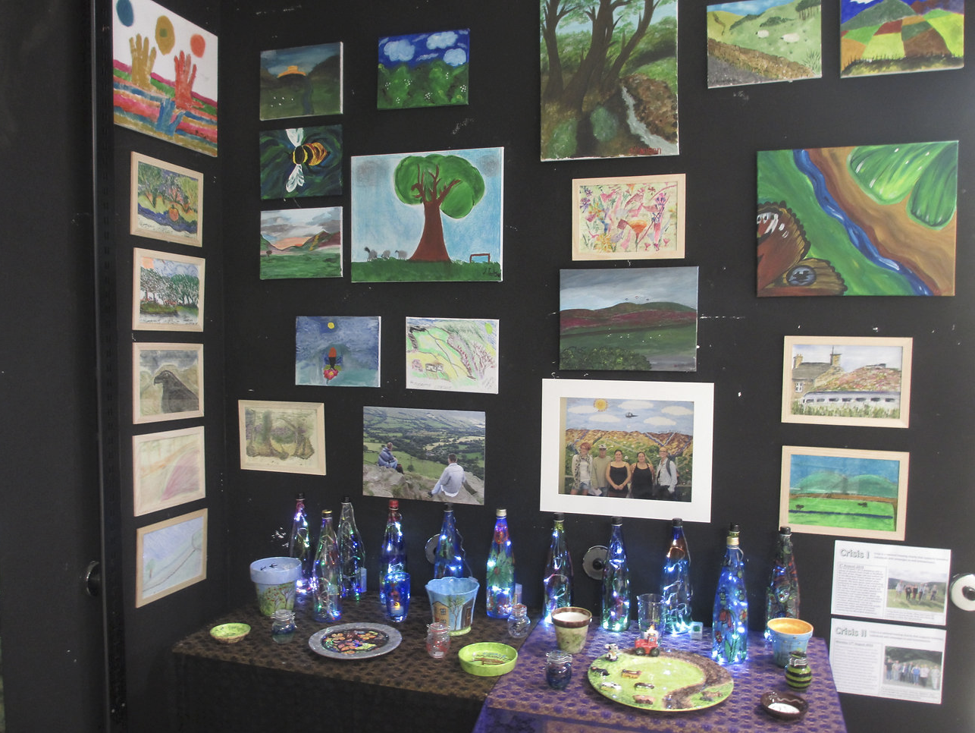
The Moorland Wonderscape project I led in the Peak District was adapted around the motivations of the Moors for the Future Partnership to educate the public and engage them in their community research initiative, and the University of Sheffield Landscape Department whose research focused on access of urban communities to the countryside. The requirements of the funders were thankfully flexible enough to allow me to design a project which mutually benefited all parties.
More recently, I have joined a tech start-up, Sycomore, that is trying to bring together artists and scientists with sponsors in a cyclical model to generate funding for research that leads to meaningful systemic environmental reform.
-
Thinking about the future, what kinds of creative initiatives or public art projects do you believe could meaningfully support the green transition across Europe?
I’m always a big fan of children’s books as a tool not just to support learning to read but also to educate on important issues for the future of society, so I’d love to see more illustrated literature used in schools that supports the green transition.
Exhibitions in public spaces are also a great way to reach diverse communities. These should be freely accessible and located in high-traffic areas. Online media is also crucial as society becomes more digitised; funding documentaries that report on the green transition and films that use storytelling to deal with environmental issues is a great way to engage and inform the public.
I also think there could be greater connectivity between high-level policy events and public engagement art. This could look like conferences and forums hosting exhibitions or inviting artists to speak or perform, and policy makers investing funding and taking the time to visit arts venues which are delivering environmental projects.
-
Finally, what advice would you give to emerging artists, activists or young people who want to use creativity as a tool for environmental and social transformation?
The key to success, as with most things in life, is persistence and adaptability. There will absolutely be times where you hit a dead end, where you have no resources, where you feel rejected and dismissed but you have to pick yourself up and keep going. Sometimes it can take a long time for a seed to bloom; the trick is to keep investing your time and energy when you can, pacing yourself so you don’t burn out, and eventually your work will achieve impact, sometimes in the most unexpected ways.
Build your networks, both through personal contacts and your online presence, because the more exposure you have the more likely someone will think of you when the right opportunity arises. Don’t try to do everything alone; ask for help when you need it whether that is manpower, crowdfunding, advice or in-kind support and work collaboratively as much as possible.
Because ultimately, we can achieve so much more when we work together. And be patient with yourself, with others and with your own expectations of the pace of change.
Expert interview by Ally Zlatar. She is an artist, scholar and activist. She is the founder of The Starving Artist; an artist initiative that utilizes creative voices as a way to create advocacy and systemic reform.