The Hidden costs of climate change
Economic risks and opportunities for change to accelerate the transition.
In the face of the climate emergency, a scientific and economic consensus is emerging: inaction consistently costs more than action. What funding challenges does the international community face? How can we understand the concrete benefits of adaptation? This overview examines the economic dimension of climate change, first on a global scale and then using France as a case study.
The costs of inaction around the world
Doing nothing to tackle climate change is infinitely more expensive than investing in the energy transition and adaptation. This conclusion, which seemed counter-intuitive, is now supported by a considerable body of economic research.
The Stern Review, commissioned in 2006 by the British government and authored by the economist Nicholas Stern, already foreshadowed today’s findings. It estimated at the time that the costs of inaction on climate change would amount to the equivalent of 5–20 per cent of global GDP on a permanent basis, compared with just 1 per cent of global GDP spent on reducing greenhouse gas emissions.
Beyond direct losses, climate change generates systemic costs that go beyond the simple sum of local disasters. Climate-induced migration, conflicts linked to the scarcity of water resources, declining agricultural yields and increased mortality due to extreme heat: these are all knock-on effects that undermine the stability of economies and societies.
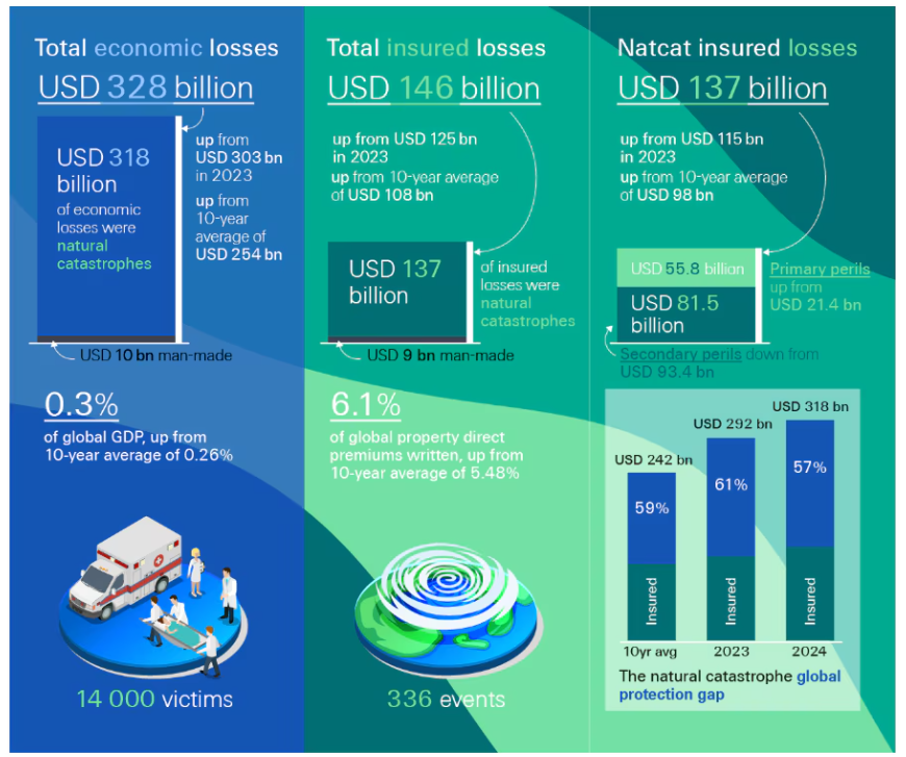
Source: World Economic Forum, Natural Catastrophes in a Nutshell in 2024
The argument that climate policies are too costly for developed economies is therefore turned on its head: it is the lack of policy that proves to be financially unsustainable.
The insurance challenge in France
France, with its coastlines, mountain ranges, coastal areas and vast agricultural lands, is particularly vulnerable to the effects of climate change.
France, with its coastlines, mountain ranges, coastal areas and vast agricultural lands, is particularly vulnerable to the effects of climate change.
ADEME (the French Agency for Ecological Transition) has published a landmark study on climate risks and their costs for France, which strongly emphasises the urgent need to act now to safeguard the national economy. The scenarios envisaged by the agency show that the costs of climate-related damage in France could reach considerable levels if greenhouse gas emissions are not rapidly reduced and if adaptation measures are not implemented on a large scale.
At European level, the insurance dimension is perhaps the most tangible and immediate indicator of the rise in climate risks.
In 2024, Europe experienced its second most costly year on record for the region in terms of insured flood damage, with events ranging from the deadly floods in Valencia, Spain, to Storm Boris, which ravaged several countries from Poland to Romania, via Slovakia and Austria. These two events alone are estimated to have cost nearly 10 billion euros in direct losses that year.
It was, in fact, in that year that the first European Climate Risk Assessment (EUCRA) was published, identifying major climate risks and highlighting the urgent need for action.
The year 2026, with the mega-fires currently raging across Europe – particularly in Spain, Portugal, France and Germany – could, unfortunately, break the record set in 2024.
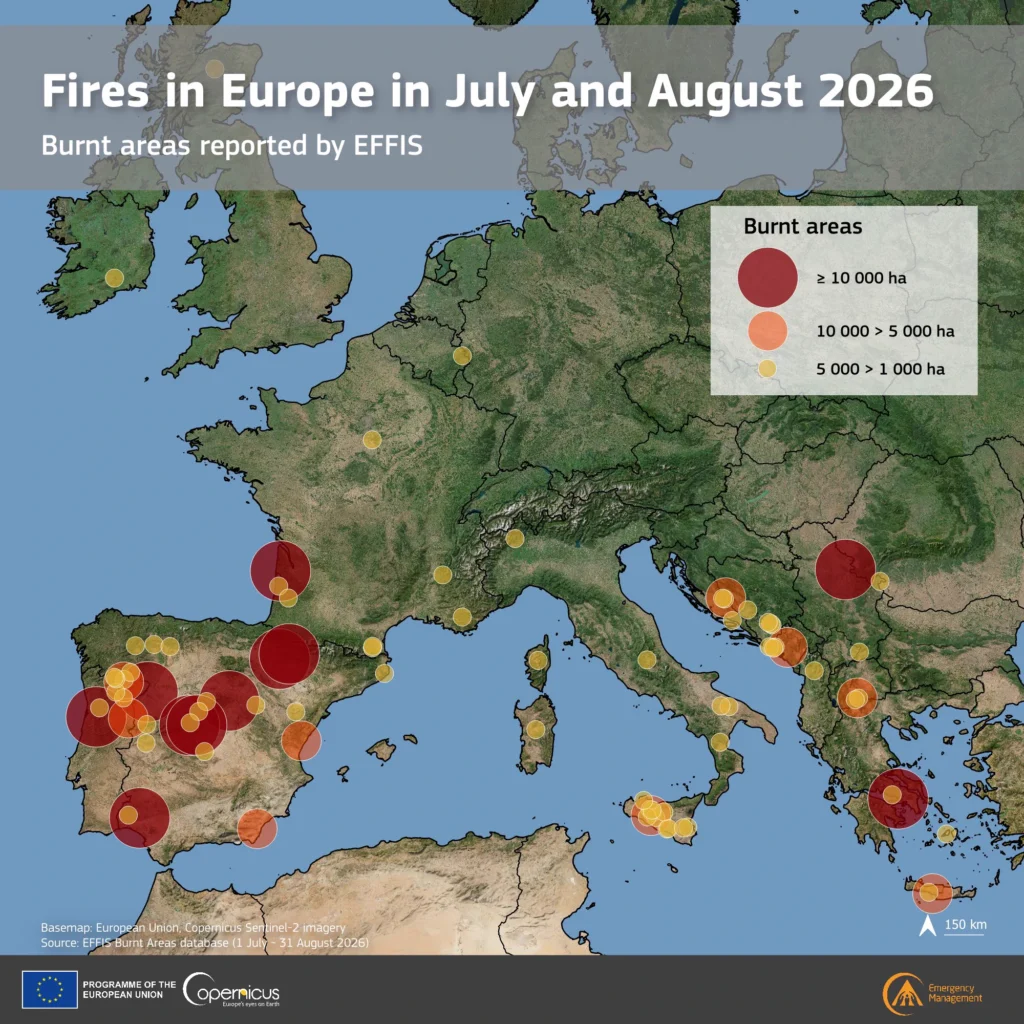
Source: EFFIS/Copernicus/European Commission
The issue of insurance highlights a wider problem: climate change creates risks that may call into question the very ability of market mechanisms to insure certain areas. Coastal zones, flood-prone valleys and urban neighbourhoods affected by the urban heat island effect could gradually become uninsurable, with direct consequences for the value of property assets and for households’ ability to find accommodation or take out loans. Let us recall the words of Henri de Castries, the former CEO of Axa, who stated in 2015: ‘A world with a 4 °C rise in temperature is no longer insurable. ”
It is against this backdrop that there is an urgent need for an ambitious public adaptation policy, which can no longer be regarded as a luxury or a deferred investment. France has a National Climate Change Adaptation Plan (PNACC), but its implementation and funding remain insufficient given the scale of the challenges identified.
Other countries that are particularly vulnerable to climate change have already adopted similar plans, such as Spain, which sets out 81 lines of action and 18 priority areas of work to adapt the economy and society in its 2021–2030 National Climate Change Adaptation Plan (PNACC). These plans are in line with the European Commission’s 2024–2029 policy guidelines and are fully consistent with the European Climate Change Adaptation Plan (ECCAP), which is designed to support Member States in planning for preparedness and resilience.
Benefits far outweigh the costs
Whilst the costs of inaction are well documented and alarming, the costs of adaptation are often presented as a major financial obstacle. However, this view tends to overlook the other side of the equation: the considerable benefits. Whether we are talking about economic, social or environmental co-benefits, investments in climate resilience bring with them a host of positive externalities.
Quantifying the overall cost of adapting to climate change is a complex task. Several recent reports have, however, helped to provide a clearer picture of the scale involved.
Globally, the UNEP (United Nations Environment Programme) estimates in its 2025 report on the adaptation gap that adaptation funding needs in developing countries will reach $310 billion per year by 2035, and up to $365 billion based on the needs set out in the Nationally Determined Contributions (NDCs). These figures represent a significant update to previous estimates, reflecting the accelerating pace of climate impacts.
Several priority adaptation sectors need to be addressed: water management (droughts, floods), adapting buildings to heatwaves, coastal risk prevention, the transformation of agricultural systems, and strengthening biodiversity as a buffer against climate hazards. Each of these sectors involves both significant investment costs and the potential to avert potentially substantial future damage. According to the Systemiq 2025 report, every euro invested in adaptation would generate the equivalent of 4 euros in benefits.
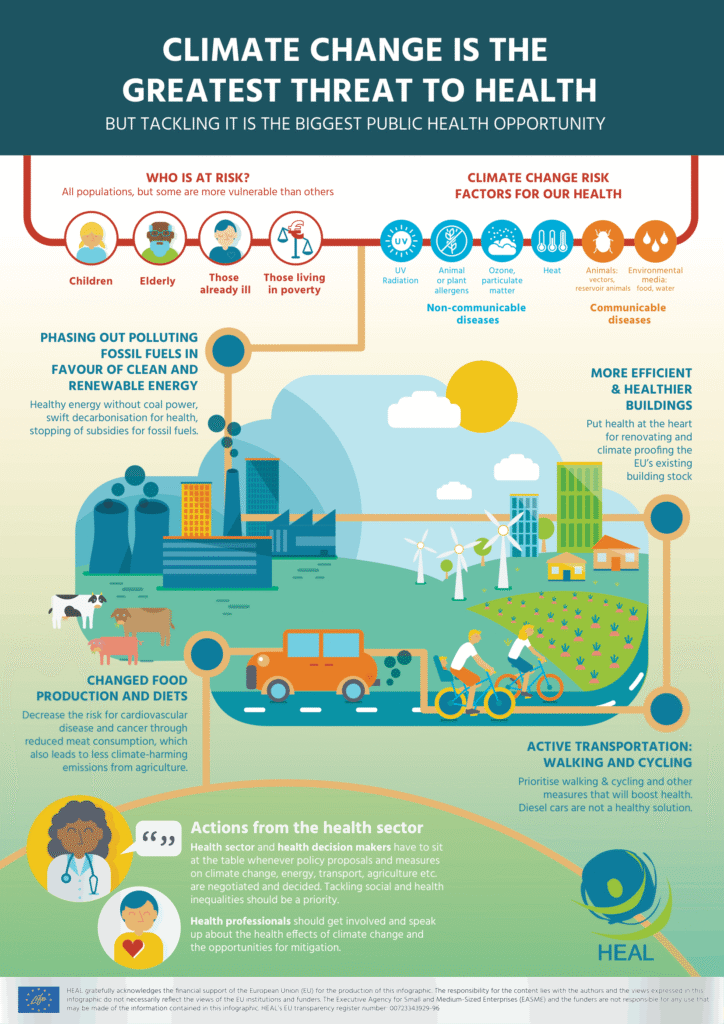
Source: HEAL organisation
The multifaceted benefits of adaptation
The direct economic benefits are substantial: according to studies cited in UNEP reports, every billion dollars invested in coastal flood adaptation results in a reduction of 14 billion dollars in economic damage. This ratio illustrates the powerful economic rationale for preventive investment.
At local and urban levels, addressing adaptation raises fundamental issues of social justice. Alexandre Florentin, a Paris city councillor and author of a cross-party report on the capital’s adaptation to climate change, ‘Paris at 50 degrees: bake, flee or act’, emphasises that climate impacts, particularly heatwaves, profoundly exacerbate existing inequalities.
In macroeconomic terms, the Systemiq report estimates that, in certain vulnerable economies, well-targeted adaptation investments could increase GDP by 15 per cent by 2050, whilst strengthening fiscal stability and reducing sovereign debt risks.
The global market for adaptation and resilience is estimated to be worth $1,300 billion a year by 2030, according to the report. This emerging market offers considerable opportunities for businesses, investors and regions capable of anticipating and positioning themselves within the new climate economy.